Traditionally, heavy industry has impacted and shaped the identity of the communities that have surrounded it.
Industries such as shipbuilding, steel, and coal mining, to name a few, have all cast long shadows over the places that have proudly affiliated parts of their identity with these industries, often even after they have left. In the case of North Sea oil production, however, the physical edifice that casts that shadow stands not in the centre of a community, but invisibly over the horizon.

With its workforce being drawn not from a single local community, it is instead gathered from all around the world, forming a new temporal community onboard any given installation.
Whilst that shadow can be felt and seen in other indirect ways, the invisibility of offshore oil production creates a unique social structure for those who are within it. A sense of group identity based on their shared experience develops amongst those who live and work there, alongside a sense that only those who have lived it truly understand what it is like.
These social structures and communities found within the workforce of the North Sea oil industry are typically under-documented. Due to the various logistical and political barriers, both real and imagined, their histories (with a few notable exceptions) have mostly gone undocumented. The imagery we see from this industry typically exhibits a level of polish and an adherence to corporate identity, which often doesn’t reflect the lived experience of the workforce. The disconnect between these curated images and the weather-beaten reality of life on a North Sea asset often leads to a feeling of invisibility amongst the workforce.


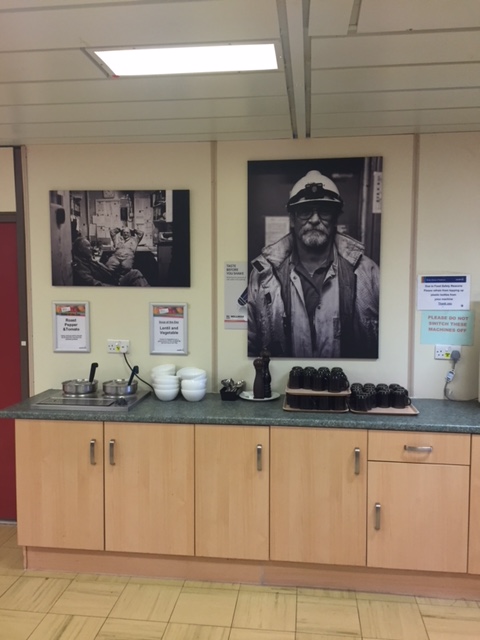
Over a two-year period, a collaborative project between Robert Gordon University (RGU), Marathon Oil and latterly Rockrose Energy sought to address this. Art students from a variety of disciplines were placed amongst their workforces. The artists were engaged to document the communities they encountered both on North Sea platforms as well as within the supporting onshore workforce, and to produce artworks that responded accordingly to what they found.
I worked as the project facilitator, working as a bridge between the oil firms and the artists, providing mentorship and support to the artists and project management for the oil companies. The resolved outcomes from this work resulted in multiple exhibitions, both onshore and onboard North Sea installations, with a book and postcards also being published. All with the aim of giving the workforce a space to reflect not only on their own experiences, but also to share these with colleagues and family.